Webinar Recap: Information Session on What to Expect from Riyadh 2026
As momentum builds toward the 6th UN World Data Forum (UNWDF) in Riyadh (planned for 9-12 November 2026), the UN Statistics Division hosted an information session on May 21, 2026, providing an update on the Forum’s evolving programme, thematic priorities, and opportunities for engagement. The webinar also spotlighted Commit to Data (C2D) as the Forum’s action platform, highlighting progress to date and opportunities to mobilize new commitments ahead of Riyadh.
With registration underway and programme development advancing, the session offered an important opportunity to re-engage the global data community, share what to expect from Riyadh 2026, and encourage stakeholders to turn priorities into concrete action through Commit to Data.
What to Expect from Riyadh 2026
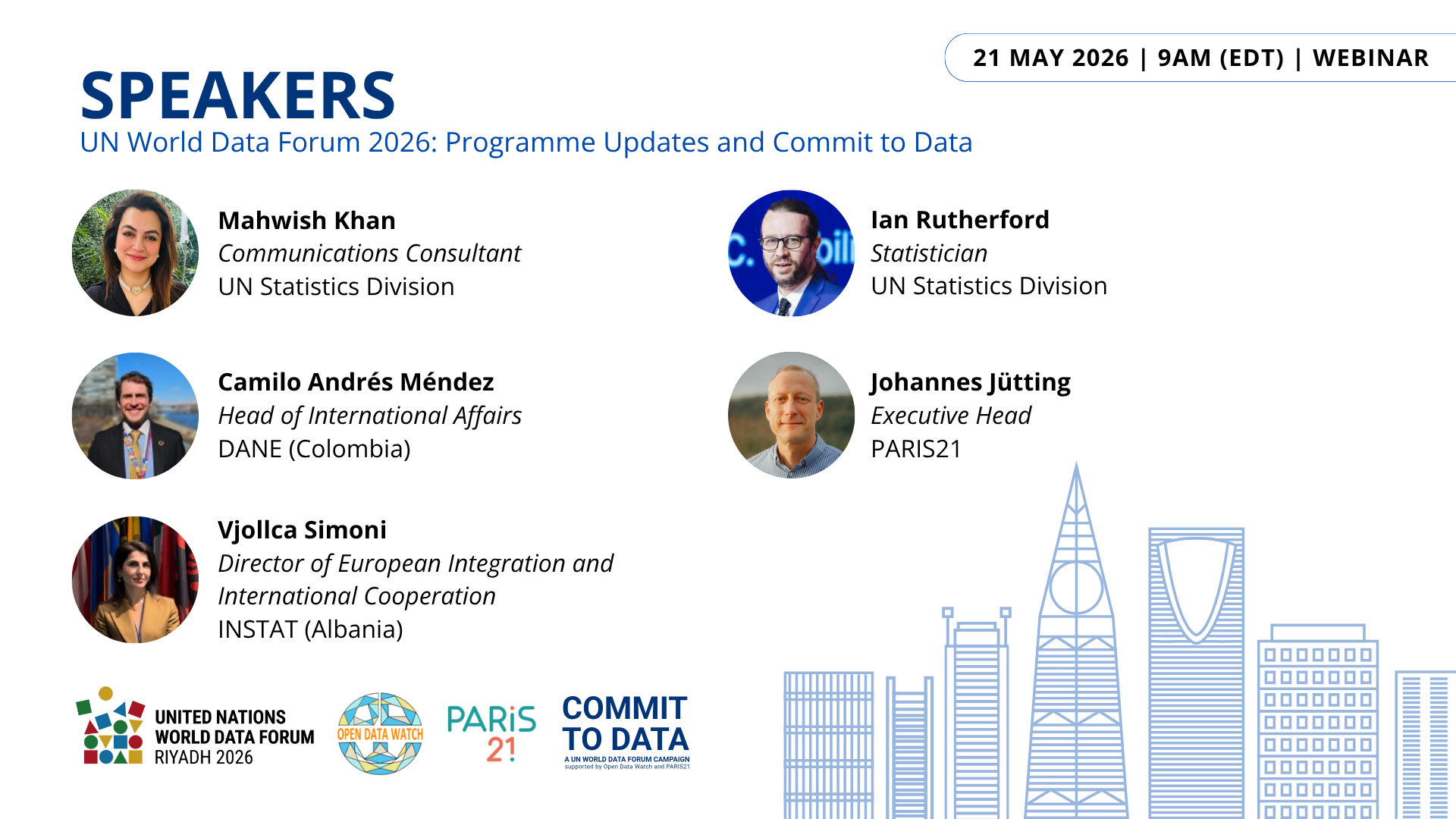
Camilo Andrés Méndez of Colombia’s National Administrative Department of Statistics (DANE) and Vjollca Simoni of Albania’s INSTAT, co-chairs of the UNWDF Program Committee, shared an overview of the emerging programme.
The Forum will bring together plenaries, parallel sessions, learning labs, innovation spaces, and networking opportunities around four thematic areas:
Innovation for better and more inclusive data
Maximizing the value and use of data for better decision-making
Building trust, protection, and ethics in data
Effective partnerships for better and more equitable data ecosystems
Ian Rutherford of the UN Statistics Division also shared reflections on the Forum’s previous outcome documents and the development of the Riyadh outcome document, highlighting opportunities for broader engagement from communities across the data ecosystem.
Commit to Data: Turning Ambition into Action
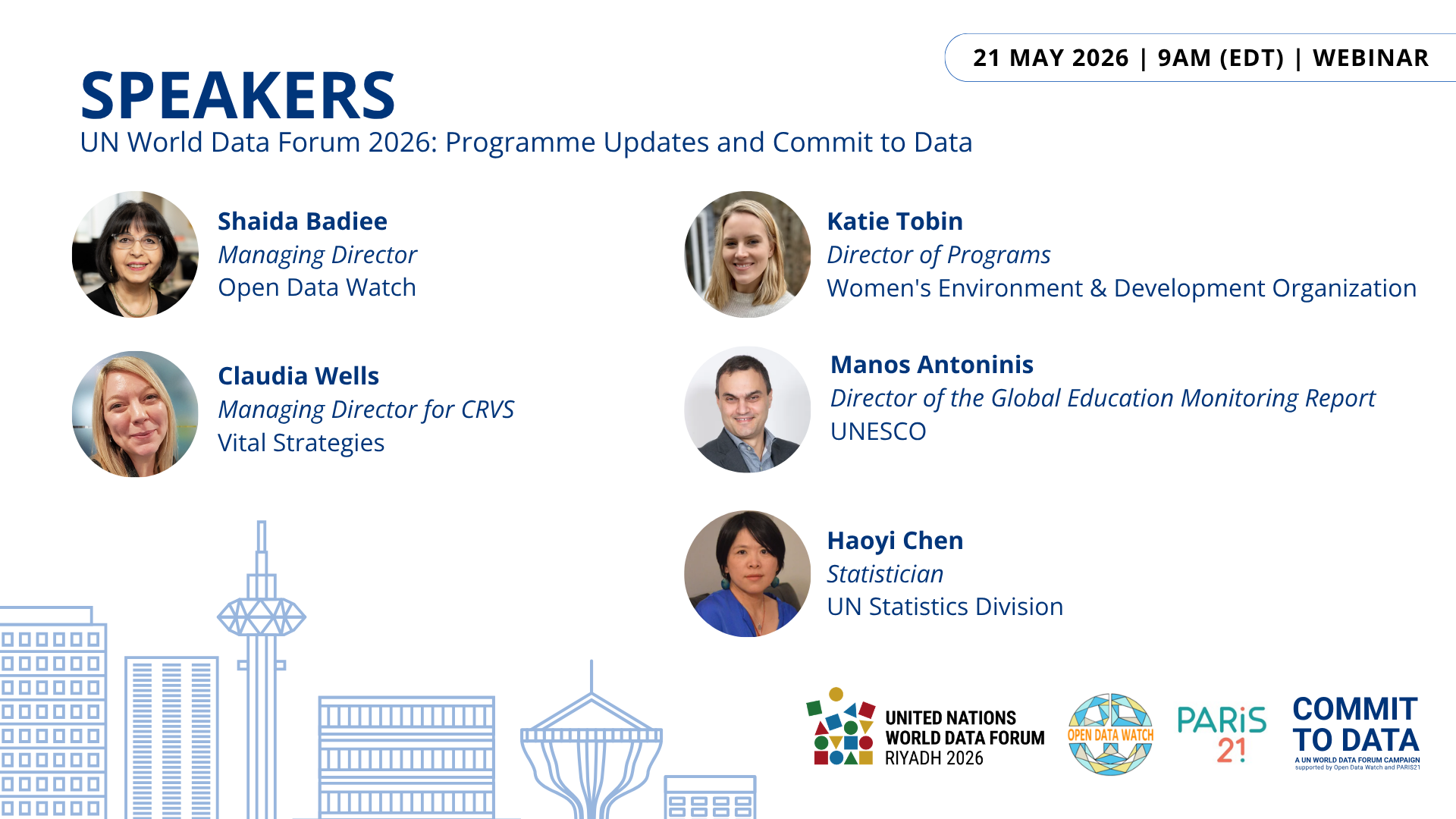
Johannes Jütting of PARIS21 and Shaida Badiee of Open Data Watch, co-leads of the Commit to Data Secretariat, highlighted the initiative’s growth since its launch at the 2024 UN World Data Forum in Medellín.
Commit to Data has now grown to 80 commitments involving more than 200 organizations, spanning local, national, regional, and global initiatives. The commitments address issues including inclusive data, gender data, smarter data financing, AI for official statistics, partnerships, and local data.
The initiative provides a platform for organizations to accelerate impact, connect with new partners, increase visibility for their work, and turn intentions into measurable change. Participants were encouraged to consider new commitments in emerging areas such as AI and data readiness, trust and misinformation, and demonstrating the impact of data at the local level.
Commitment Makers in Action
The session also showcased three commitments demonstrating how organizations are translating these priorities into action.
Strengthening sustainable and country-owned demographic and health data systems
Manos Antoninis of UNESCO and Haoyi Chen of the UN Statistics Division presented the Inter-Secretariat Working Group on Household Surveys (ISWGHS) commitment to develop a blueprint for sustainable, country-led demographic and health data systems.
The commitment responds to disruptions in financing for the Demographic and Health Survey program and aims to strengthen coordination, international standards, data harmonization, data access, South-South cooperation, and financing. More than 50 countries have already engaged in the process, with the blueprint expected to be presented to the UN Statistical Commission in 2027.
Strengthening civil registration and vital statistics
Claudia Wells of Vital Strategies highlighted a commitment focused on strengthening civil registration and vital statistics (CRVS) systems. The work supports stronger birth and death registration, mortality surveillance, and the production and use of vital statistics for evidence-based policymaking.
Wells emphasized that sustainable progress depends on country ownership, institutionalization, cross-sector collaboration, and digital transformation—helping ensure that people are counted and that vital data can inform better policies and services.
Advancing gender and environment data through community-led action
Katie Tobin of the Women’s Environment and Development Organization (WEDO) shared progress from the Gender and Environment Data Alliance (GEDA) commitment, which uses a small grants programme to support organizations producing and using gender and environment data.
Since 2024, the programme has supported 16 organizations, primarily working at the local level in the Global South. One highlighted project in Uganda used participatory approaches to document the impacts of climate change on wetlands while strengthening community ownership of the data. GEDA plans to launch another round of grants and expand collaboration with national statistical offices.
What’s Next
As the Road to Riyadh continues, Commit to Data will provide opportunities for organizations across the data ecosystem to turn shared priorities into action, build partnerships, and showcase progress at the Forum.
The initiative will be integrated throughout the Riyadh 2026 programme, including thematic sessions, launch events, and other opportunities to highlight commitments and their impact.